Museum-going tends to happen when Max and I have visitors, and with A. in town the past week has been a whirlwind of white corridors, polished floors, and hushed galleries.
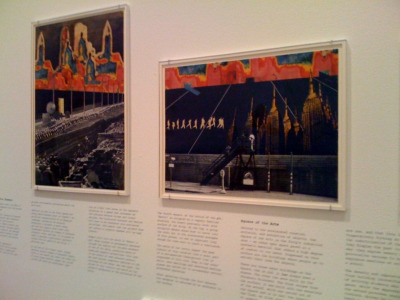
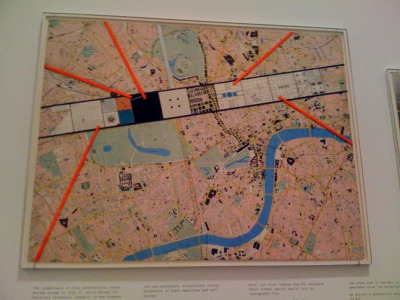
At the MOMA, I was finally able to see Rem Koolhaas’ 1972 architectural thesis, Exodus, or The Voluntary Prisoners of Architecture, in full. In this project, the Dutch architect envisons a walled linear structure cutting London in half. The accompanying prologue begins:
Once, a city was divided in two parts. One part became the Good Half, the other part the Bad Half. The inhabitants of the Bad Half began to flock to the good part of the divided city, rapidly swelling into an urban exodus. If this situation had been allowed to continue forever, the population of the Good Half would have doubled, while the Bad Half would have turned into a ghost town. After all attempts to interrupt this undesirable migration had failed, the authorities of the bad part made desperate and savage use of architecture: they built a wall around the good part of the city, making it completely inaccessible to their subjects.
The Wall was a masterpiece.
Before I interviewed Rupert Thomson a few years ago, Joseph (my architectural theorist brother-in-law) suggested that I ask about the influence of the Koolhaas project on Thomson’s 2005 novel, Divided Kingdom. (The author has named both his time in Berlin and Koolhaas’ S,M,L,XL as inspirations.)
I did mention Exodus, but my question was so dense and meandering that Thomson didn’t speak to that part of it. Now that I’ve had a chance to look over this fragmented London in more detail, I wish I’d followed up. The Park of the Four Elements — devoted to Air, Desert, Water, and Earth — seems particularly germane to the novel and its themes. Here’s a little bit from Koolhaas’ description:
Divided into four square areas, the Park of the Four Elements disappears into the ground in four gigantic steps. The first square, “Air,” consists of several sunken pavilions overgrown with elaborate networks of ducts that emit various mixtures of gasses to create aromatic and hallucinogenic experiences. Through subtle variations in dosage, density, and perhaps even color, these volatile scented clouds can be modified or sustained like musical instruments. Moods of exhilaration, depression, serenity,and receptivity can be evoked invisibly in programmed or improvised sequences and rhythms. Vertical air jets provide environmental protection above the pavilions.
Identical in size to the first square but sunken below surface level is “Desert,” an artificial reconstruction of an Egyptian landscape, simulating its dizzying conditions: a pyramid, a small oasis, and the fire organ — a steel frame with innumerable outlets for flames of different intensity, color, and heat. It is played at night to provide a pyrotechnic spectacle visible from all parts of the Strip, a nocturnal sun.
At the end of tour linear caves, mirage machines project images of desirable ideals. Those in the Desert who enter the tubes run to reach these beatific images. But actual contact can never be established: they run on a belt that moves in the opposite direction at a speed that increases as the distance between mirage and runner shrinks. The frustrated energies and desires will have to be channeled into sublimated activities…