
On being intimidated by a favorite writer’s work
February 7, 2010 | 26 Comments
I’m focused on my own writing right now, thus the dearth of longer posts, slowdown in reviewing, and trickle of remainders. I feel guilty about it, if that helps.
A couple weeks ago, I was reading Rupert Thomson’s gorgeously evocative, meticulously pared-down This Party’s Got to Stop.
About a third of the way through, I had to take a break. The essay I’m writing had stalled. My verbs seemed unconscionably obvious next to his, my sentences clumsy, my narrative voice about as natural as a conversation heard through a tin horn. I was, as always, struggling with structure.
“I try to take comfort,” I told Rupert, in email, “in the knowledge that This Party is, what, your eighth or ninth book? Surely I’ll get better.”
He assured me:
[Y]es, you WILL get better. We all get better. I can definitely imagine being on my deathbed & thinking, ‘Oh, not now, please; I was just beginning to GET somewhere…’ Who was it who said that a writer’s biography is not the details of his life, but the story of his style. Nabokov maybe.
Of course this isn’t the first time I’ve been so overwhelmed with admiration for someone else’s work that I could barely stand to look at my own. I’m guessing the neurosis is a lifelong affliction — and, judging from conversations with friends, it’s a fairly common one.
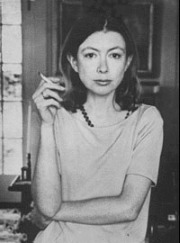
Joan Didion suffered from an extreme case of awe-inspired paralysis. She told The Paris Review that, while Henry James was as formative as influence on her writing as Hemingway, she could no longer read him at all.
He wrote perfect sentences, too, but very indirect, very complicated. Sentences with sinkholes. You could drown in them. I wouldn’t dare to write one. I’m not even sure I’d dare to read James again. I loved those novels so much that I was paralyzed by them for a long time. All those possibilities. All that perfectly reconciled style. It made me afraid to put words down.
Can you imagine? The formidable Joan Didion, reduced to silence by her love of someone else’s words?
For occasions like this, for the past couple years, I’ve kept on hand a well-reviewed novel that I don’t like or respect. It’s sitting on my desk right now, in fact. I don’t re-read it in any detail, because I don’t want it to contaminate my thinking, but flicking through the book makes me feel better about my own work, however imperfect it may be.
But see Dani Shapiro’s reaction, in the Los Angeles Times this weekend, to an acquaintance who said, “So many crappy novels get published. Why not mine?”
If you can relate — or if you can’t — I’m curious about your experiences and I’ve opened up comments.
Comments
26 Responses to “On being intimidated by a favorite writer’s work”
February 7th, 2010 @ 5:55 am
People often ask me why I don’t try to be published, and one reason is that I don’t envy that sort of success, but the despair which comes of comparing my own writing to that which is infinitely superior is indeed paralysing. Perhaps there’s comfort in what Thomson says. Some. With hard work and unflinching self-criticism, we’re bound to get better – but as good as we’d like? My feeling is that it’s the very awareness of our limitations which drives us to try to overcome them.
February 7th, 2010 @ 9:47 am
The craft of writing however essential and important is sterile and barren without a story that is integral to the world we inhabit, identify with or can envision. Loving words and beautiful sentences need to connect to something that transcends the words to meaning to a greater understanding of the world we live in.
Now, when I was in the army a long time ago I did not think of beautiful round sentences, though I did think of writing a coherent story out of the chaos of organized military and political actions.
When I think of writers I think of those who really tried to grasp our world with their travels, though Thoreau proved travel is unnecessary. Maugham, Melville, Twain, Orwell(Burmese Days), Hemingway, London and others slid the earth with its people and cultures in their hands and gazed at it and wrote about it.
Increasingly there is a disconnect between the meaning of our best literature and the world we inhabit. It is as if technology alone is advancing mankind along a mirage horizon. You can trek in a desert with a laptop, an all terrain vehicle and a GPS. You will still see a mirage when you are thirsty and dying of thirst.
February 7th, 2010 @ 9:59 am
Great thinking keeping a rubbish book to bolster confidence.
In 2008 I published my third novel. It and those prior each required talismans of this sort.
February 7th, 2010 @ 12:44 pm
When I was walking over to meet George Saunders for the first time, I kept thinking “Don’t tell him how much you steal from him… don’t tell him how much you steal from him… Say anything except how much you steal from him.” His first words were, “I was reading your book on the airplane. I feel like we were separated at birth.” And I said, “That’s because I steal from you so much.” After that, I sent him like 1,000 emails trying to explain that I didn’t REALLY steal from him, and what I REALLY meant, and I’m pretty sure I appeared to be a raving lunatic. He never once made me feel crazy or like a stalker, and was very gentlemanly and kind in his responses. So I guess to answer your question, it’s like when Flannery O’Connor was asked if creative writing programs stifled young writers and she said, “They don’t stifle enough of them.” In other words, there’s probably something to be said for intimidation, and I haven’t been intimidated ENOUGH.
February 7th, 2010 @ 1:43 pm
Here is Virginia Woolf’s version:
“Proust so titillates my own desire for expression that I can hardly set out the sentence. Oh if I could write like that! I cry. And at the moment such is the astonishing vibration and saturation that he procures–there’s something sexual in it–that I feel I can write like that, and seize my pen and then I can’t write like that.”
When I am reading someone like Didion, even though she is in a way so stylized, she is also like the clearest water, and I am always surprised, every time, that I “seize my pen and then I can’t write like that.”
February 7th, 2010 @ 2:13 pm
(Maud, a few of us had a little exchange today in the comments over at TEV (about flawed first novels) that might interest you.)
I think the short story and the novel are very different in the “intimidated by great writers” department. I find that most great novels are flawed, and so I find something to be both inspired and encouraged by in every book I love. In other words, I don’t think any novelist is brilliant at every aspect of novel-writing. (I just finished the remarkable The House in Paris by Elizabeth Bowen, for example. I have never read anything like it and will read it again and again, I think; but there is this substantial dialogue section in the middle that feels weird and forced. I love this flaw as much as anything.)
A short story, on the other hand, can in fact be perfect. I find this can be paralyzing, yes.
Also, I tend to agree with the adage that everything you write is essentially a kind of revision of the last thing you wrote. I have every hope that the book I am writing now is better than the book I wrote two years ago. I know for sure that it’s riskier, at any rate; for me, that’s really the ball game right there.
Last thought: I have found it’s quite true that how you “feel” about what you’re writing as you are writing it is ultimately unreliable. I have gone back to pages the next day and been surprised by how good, or bad, they are in the light of (emotional) day. Which is good motivation I think to “just do it.” Keep writing that scene, that setting description, that monologue, no matter how you feel about it; get the words down, or at least a few.
February 7th, 2010 @ 3:55 pm
Oh Jesus god yes. And it doesn’t even have to be in my field of writing. Most recently Elfriede Jelinek’s Wonderful Wonderful Times cracked my head open and all the words to my ongoing poetry project fell out. I had to read some crap to fix things.
Rebecca Loudon
February 7th, 2010 @ 4:22 pm
The writers I admire are able to condense a thought that I’ve been rolling around (for years) in the form of a paragraph into a single sentence. I’m envious of that but I also feel it as a validation to know that others see certain aspects of the world the same way.
Sometimes I’m overwhelmed with a generic fear about overcoming the utter futility of it all, w/r/t writing. Certainly not enough to ever stop.
I agree with Sonya’s point about novels and short stories.
February 7th, 2010 @ 4:58 pm
I’m a newcomer to your blog, Maud; I’m really enjoying it.
I think Sonya points out a crucial distinction between novels and short stories. I once heard a novel defined (I’m paraphrasing) as “a narrative of a certain length with something wrong with it.” (Someone famous said that–can’t remember who.) Thus, a novel’s excellence has never made me want to give up writing; no matter how good the book, there’s always a plot twist too contrived or dialogue that rings false or a subplot that feels superfluous. But I still remember a Joyce Carol Oates story (“The Fabled Light-House at Vina del Mar”) that made me say to myself, “Well, if you can’t do that, then what’s the point?”
That hopeless feeling is real, and so are the rejection and uncertainty chronicled in Solotaroff’s and Shapiro’s essays. These probably explain why I’ve never consistenly been one of those write-every-day writers. I get fired up and have long periods when I crank out tons of copy, and then somehow I lose momentum and go weeks or even months without writing a word. But I keep coming back. I don’t know how, or even why, I keep coming back. I just do. May we all do the same.
February 7th, 2010 @ 11:58 pm
For what its worth, I think all writers, individuals compelled to improve upon their craft, deals with such self-doubt sooner or later. I’m left reeling after reading my favorite authors, but I suppose I try to approach it as a learning experience.
I could cease writing, completely jack the author’s style or come to appreciate the author’s strengths, to then try to hone my own. But that’s usually after a bout of creative paralysis. In the end, all you have is the belief in your own art; I suppose such belief separates those who quit and those who press forward.
February 8th, 2010 @ 11:03 am
Stephen King said in a talk that a magical moment happens in an aspiring writer’s life when he/she reads a book and thinks, “That was sh*t! I can do much better!”
By that token, I keep awful sci-fi novels around for motivation
February 8th, 2010 @ 11:32 am
I thought it was just me. I realize that every author, at some point, must suffer from self doubt and the breakdown of editorial decisiveness but the inability to produce based on the awe of other author’s work? I really thought I was alone in that. I sometimes feel the weight of the literature on my bookshelves pushing me down in my seat and have seriously considered writing in an empty room to alleviate the problem.
Thank you for the inspiring blog. It’s a truism but knowing that others have the same fears and thoughts DOES help!
I haven’t, up till now, kept a rubbish book to bolster my confidence but I will certainly consider The Da Vinci Code for that honor! I remember thinking when I read it that I should have hope for my own writing.
February 8th, 2010 @ 1:13 pm
It’s very comforting to know that I’m not the only one who feels this way. No matter how pleased I am with something I’ve written, I always end up reading someone else who just seems a whole level above whatever I’m doing. I guess this shouldn’t surprise me, and, the more I think about it, I should be glad. Because it means I will always have someone and something to aspire to.
It’s like a story my grandmother used to tell about my Uncle Bob when he was a little kid. Bob always wanted to do what his older brother (my dad, Bill, Sr.) was doing, no matter what it was, and his parents constantly countered with, “You can do that when you are as old as your brother.” Finally one day, exasperated, Bob said, “WHEN am I FINALLY gonna be as old as Billy?” By the time he was old enough to do one thing, he was already looking ahead to the next thing.
Now, Maud, I can only hope that the bad novel you keep on hand is not the one I sent you.
February 8th, 2010 @ 3:43 pm
This is why I had to learn how to undo my BA in English in my head, and why it took twenty or so years to do so: reading (and inevitably comparing oneself to) Henry James, Virginia Woolf, Eudora Welty, etc., not to mention my own, “non-canonical” reading of writers like Alice Munro and Toni Morrison, was a real creativity-killer, at least it was for me. Now I just forge ahead, doing my best. And while I’m writing I mostly read outside of my chosen genre, which helps.
February 8th, 2010 @ 3:46 pm
The work of a favorite writer typically exists on such a higher plane than what I consider my own ability that I tend not to let its perfectness affect what I try to do when I write. My peers are my other unpublished or only-occasionally-published friends who write. Sometimes their work is very good, but it doesn’t prevent me from thinking that my own work can’t be very good. An established writer whom I admire is certainly not a peer.
So how do I know when I’ve written something good? For now, it’s when I read it over five or so times and don’t hate it.
You have to trust your ability to get better just as you must presume the other writer did. It’s really not fair, in a way; you get to see all of your own early flawed drafts and mistakes, but usually only the finished product from the other guy.
February 8th, 2010 @ 5:13 pm
[...] else’s links to genius, I came across this little pearl tweeted by Electric Literature, a blog post by Maud Newton. Posting this just yesterday, what she addresses is exactly what I’m talking about above, [...]
February 8th, 2010 @ 7:20 pm
It never gets easier, Maud. Which is why you should never compare yourself to others. EVERY writer has another writer they wish they could write like, be as good as.
If you want *real* paralysis, start thinking about how we’re nothing but mobile bags of meat manipulated by chemicals and electrical impulses. That will REALLY make you want to despair.
February 8th, 2010 @ 9:07 pm
All right, I’m going to ask what no one else did (and which you probably won’t divulge anyway, but worth a shot): What’s the title of the awful book you keep on your desk? I’ll tell you mine if you tell me yours.
February 8th, 2010 @ 10:49 pm
[...] Read More [...]
February 8th, 2010 @ 11:46 pm
I just wanted to say that I enjoyed this topic and the comments and links material very much. I’ve read your blog and enjoyed it for three years now and never seem to find the comments open. So I’m taking advantage. As a poet I can’t really offer you much advice except to keep looking for the right words and when you think you’ve found them, trust yourself and move on. I wish you every success.
February 9th, 2010 @ 2:35 am
[...] Maud’s blog post here: http://maudnewton.com/blog/?p=11414 the rest of it is rather good [...]
February 9th, 2010 @ 7:02 am
[...] Maud Newton has. She confesses: A couple weeks ago, I was reading Rupert Thomson’s gorgeously evocative, [...]
February 9th, 2010 @ 3:23 pm
I think that the more experienced you become as a writer, the more likely this is to happen. I suffer paralysis frequently and I find writing so much more grueling than I did 20 years ago, as a freshman undergraduate. Today, as a doctoral student, writing is much slower than it used to be. Seems like writing should become easier, but maybe it’s because it’s so laden with meaning, it gets harder.
February 10th, 2010 @ 11:21 am
Is that my novel that you keep on your desk and flip through to remind yourself how decrepit and lame my prose is? I can hear your high F# “hee-hee’s” as you read this. Hell, if I was a writer I would be intimidated by the prose in your legendary ancestry posts alone and some of the comments here when you open them up. Not to mention L. Durrell, Freya Stark, Pirandello, Eudora Welty, Chekhov and a few thousand others who have helped me glimpse the palaces of the heart.
February 10th, 2010 @ 11:16 pm
[...] her essay about being intimidated by writers you admire. It’s so [...]
February 11th, 2010 @ 12:49 pm
Jack, I can see the kinship between you and Saunders, but your writing is your writing is your writing. I’m reading your latest book on my phone and getting a big kick out of it.
Sarah, I can relate, in a way. It took three years of law school to counteract the lit-crit focus of my English major background. It’s hard to write fiction when you believe language should “be overthrown” (whatever that means; in hindsight, I’m not really sure).
Sonya, I do see what you mean about long and short forms. Many of my favorite novels are ambitious, sprawling, manic, and imperfect things. “Crime and Punishment,” for instance — utterly engaging, undeniably brilliant, but still, at times, wtf?! On the other hand, I’d put “The End of the Affair” (my very favorite book) up against just about any short story for structural perfection. “Giovanni’s Room,” too. They’re warmer than, for instance, Flannery O’Connor’s stories, but just as finely honed, in my opinion.
Edwin, here’s what I said about the book when I was first slogging through it. I promise no one who commented here has any connection to it.
Thanks for leaving your thoughts, everyone. I really enjoy reading them.