
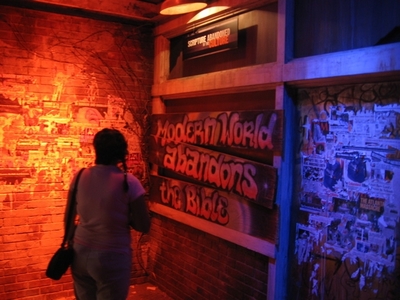
Last year Joseph Clarke, my brilliant brother-in-law, visited the Creation Museum, a Kentucky theme park that “crackles with all the animatronic and multimedia glitz that one might expect from a museum founded by a former Universal Studios executive, and it seems to be doing a booming business.”
“Rather than present a coherent argument for a particular view of life’s origins,” Joseph said, “the exhibitions encourage visitors to question the scientific method and the institutions of modern science… [A] sensory overload of animations, dioramas, and plaques about contested scientific theories seems to dissolve any kind of rational engagement with natural history; in this digitally-enhanced intellectual fog, the only sure anchor is given in the immutability and univocity of a literal reading of Genesis as an ‘eyewitness’ account.”
Now, in Specters of a Young Earth, just out at Triple Canopy, he looks at the Museum from an architectural and design perspective, examining the hostility of the park’s fundamentalist acolytes toward urban environments and their affection for “nature.”
[T]he exodus from cities, beginning with the first planned suburbs in the mid-nineteenth century and accelerating with the expansion of the highway system a hundred years later, has had religious undertones. Bucolic touches like artificial hills, winding cul-de-sac roads, and oversize lawns have persisted in these subdivisions like antitypes of Paradise. The architect Rem Koolhaas uses the term “Edenic residue” to describe the swaths of vegetation that give residential neighborhoods and office parks their arcadian character — endlessly manicured yet implicitly primitive, they balance out the artificiality of the surrounding development with their prelapsarian overtones. Appropriately, one of the Creation Museum’s high points is a walk-through diorama of the Garden of Eden. It’s a large space full of colorful plants and realistically modeled creatures that includes mannequins of Adam and Eve, naked but fortuitously covered by vegetation and props. Through gaps in the foliage, one can see the building’s blank walls and ceiling; lights are suspended from a structure overhead, and no attempt is made to conceal the red EXIT sign blaring the way to the next room. Nature reduced to a patchy veneer masking an increasingly synthetic environment — this is the Creation Museum, and this, too, is the American landscape it occupies.